Broadcast Intelligence Data for Analysts
A practical guide for analysts evaluating eMM’s data coverage, latency, analytics, workflows, and integration options.
Everything Data Analysts Need to Know — and Why It Matters
If you’re assessing a media intelligence dataset, you need clarity, structure, and proof—not a sales pitch.
This page provides a complete overview of how eMM’s broadcast data works, from global coverage and technical workflows to sample data formats, analytics outputs, and integration pathways.
What eMM Offers
eMedia Monitor is a real-time global broadcast data engine used by PR teams, media monitoring providers, agencies, and enterprise organisations.
The value proposition in analyst-friendly terms:
- Real-time global broadcast monitoring
- Coverage across TV, radio, podcasts, web TV, YouTube, and TikTok
- Active in 85+ countries and 3,400+ channels, 24/7
- Instant alerts, searchable transcripts, downloadable clips, analytics insights
How the Platform Works
The platform lets you define precise search profiles that return real-time clips within seconds, review and analyse transcripts, edit or export recordings, generate dashboards, and send structured metadata directly into your analytics tools.
Our simple workflow allows for:
- Create Search Profiles: Boolean queries that track brands, competitors, events, or executives.
- Collect Real-Time Clips: Matches show up within ~30 seconds on average.
- Review Clips + Transcripts: Skim, filter, transcribe, analyze, and mark key moments.
- Edit & Download Clips: Trim highlight segments or export full recordings.
- Generate Dashboards & Reports: Built-in widgets transform raw data into patterns instantly.
- Export Metadata for Analytics: Push structured outputs straight into your BI stack.
What the Data Looks Like
The data consists of time-coded audio/video clips, transcripts, structured metadata, detected entities, sentiment, keywords, and classification outputs—all accessible via the platform, export tools, or API.
Structured media intelligence data includes:
- Time-coded audio/video clips
- Transcripts with segmentation and timestamps
- Metadata: source, channel, country, programme name, media type
- Entities, sentiment, contextual keywords
- Analytics summaries and classification outputs
Gathered data can be accessed via:
- Platform interface
- CSV/Excel exports
- API
- Real-time alert feeds
| Data | Description |
|---|---|
| No | A sequential index showing the order of clips in the exported file. |
| Notification ID | A unique system-generated identifier assigned to each detected clip. |
| Profile Group | A high-level organizational folder that contains one or more Profiles. |
| Profile Group ID | A system-generated numeric identifier that corresponds to the Profile Group under which a profile is organized. |
| Profile Title | The name of the Profile whose results appear in the export. A Profile defines the specific keywords or topics being monitored. |
| Profile ID | A system-generated numeric identifier that corresponds to the specific Profile within a Profile Group. |
| Query ID | A system identifier for each query Note: This appears only in Standard Profile exports. |
| Date/Time | The timestamp the system detected and logged the clip |
| Channel ID | A numeric identifier representing the channel from which the clip originated. |
| Channel | The name of the media source where the clip appeared (e.g., the specific station, program feed, or publication name). |
| Type | The media type of the source (e.g., broadcast TV, radio, digital, etc.). |
| Country | The country where the content was broadcast. |
| Country Code | The standardized country abbreviation. |
| Language | The language of the broadcast expressed as a language code. |
| AVE | Advertising Value Equivalency: An estimated advertising value attributed to the clip by the content provider. May appear blank if not enabled for the user. |
| Audience (Reach) | An estimate of the broadcast’s audience size during the time of airing. May appear blank if not enabled for the user. |
| Duplicate Type | Indicates whether the clip is classified as repeated content based on the system’s duplicate-detection rules.
Appears only in Standard Profile exports. Duplicate types include: clip duplicate (repeated clip on the same channel within a short time window), channel duplicate (a repeated clip later on the same channel), network duplicate (a repeated clip on another channel in the same network or another station under the same broadcaster), global duplicate (a repeated clip on a completely different channel, not necessarily part of the same network). |
| Sentiment | An automated sentiment rating (positive, neutral, negative) based on the clip’s content.
Available only in Super Profiles with Auto-Summary enabled. |
| Link | A direct URL link to access the clip or content. |
| Is Mention | A system flag indicating a detected keyword instance within a clip. |
| Mention ID | A system identifier linking the detection to a specific keyword mention inside the clip. |
| A | An internal processing field used by the system for indexing or classification. |
| Clip Start Timestamp | The precise point in the broadcast where the relevant clip begins. |
| Hit Timestamp | The exact moment within the broadcast when the keyword or topic appears. |
| Headline | An automatically generated short summary highlighting the main point of the clip. Available only in Super Profiles
with Auto-Summary enabled. |
| Summary | An automatically generated longer summary describing the content in more detail. Available only in Super Profiles with
Auto-Summary enabled. |
Core Analytics Capabilities
The platform provides automated topic and entity detection, sentiment and trend analysis, volume and reach metrics, and customisable dashboards that transform broadcast data into actionable insights.
The platform analytics include:
- Theme & trend identification
- Sentiment analysis
- Competitor comparison
- Geographic and media-type breakdowns
- Peak event detection
- Report-ready visualisations
What You Can Do as a User
Users can monitor topics, receive alerts, review clips, identify key moments, build dashboards, export data, and integrate outputs via API.
A list of available options:
- Monitor brands, competitors, executives, or topics
- Receive real-time alerts
- Review clips and transcripts
- Create dashboards & reports
- Export clips, transcripts, and metadata
- Create API-based workflows
Source Coverage
eMM captures broadcast data from a global network of TV, radio, and online channels and transforms each source into structured, searchable intelligence.
The list of sources our platform can cover:
- TV
- Radio
- Podcasts
- Web TV
- YouTube
- TikTok
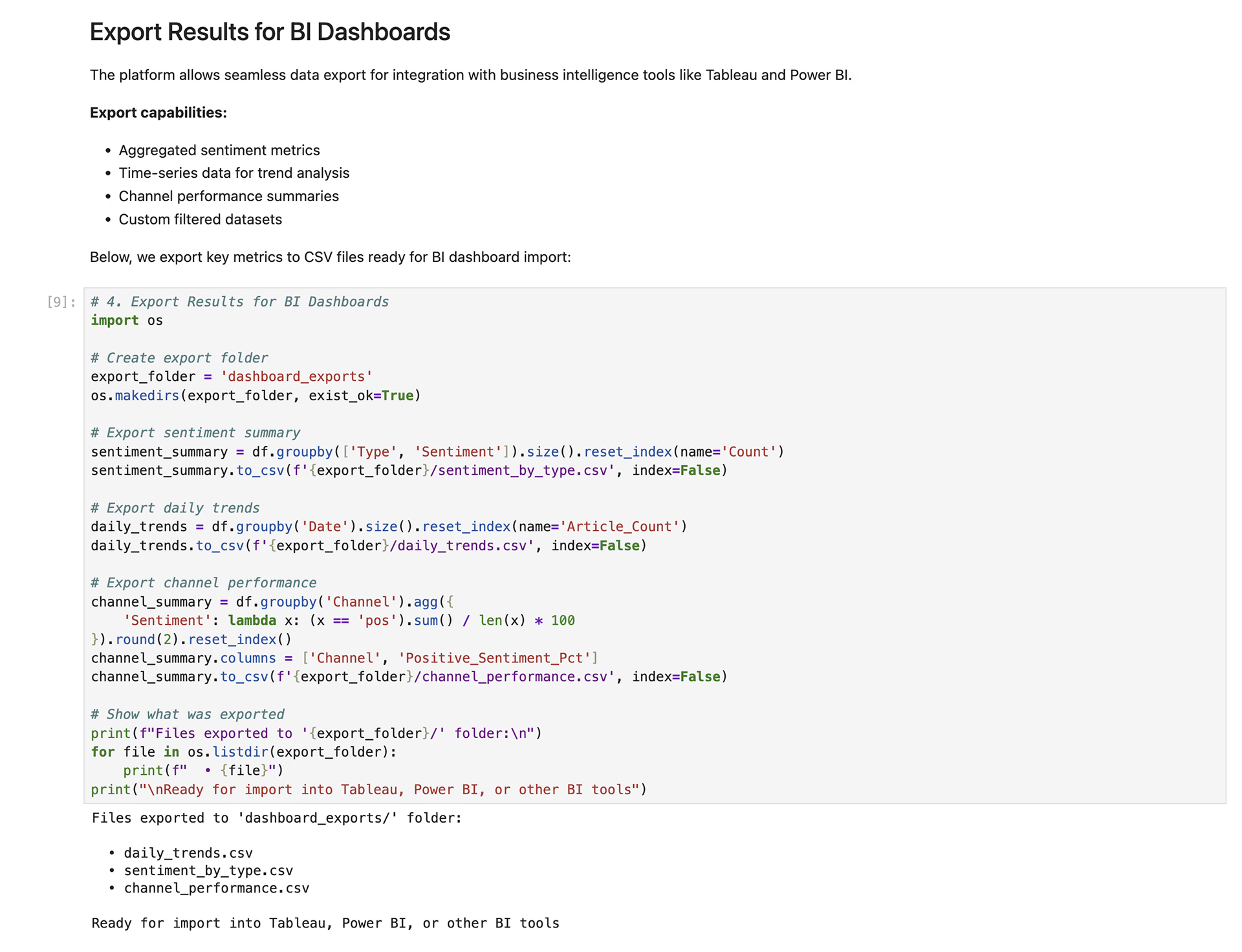
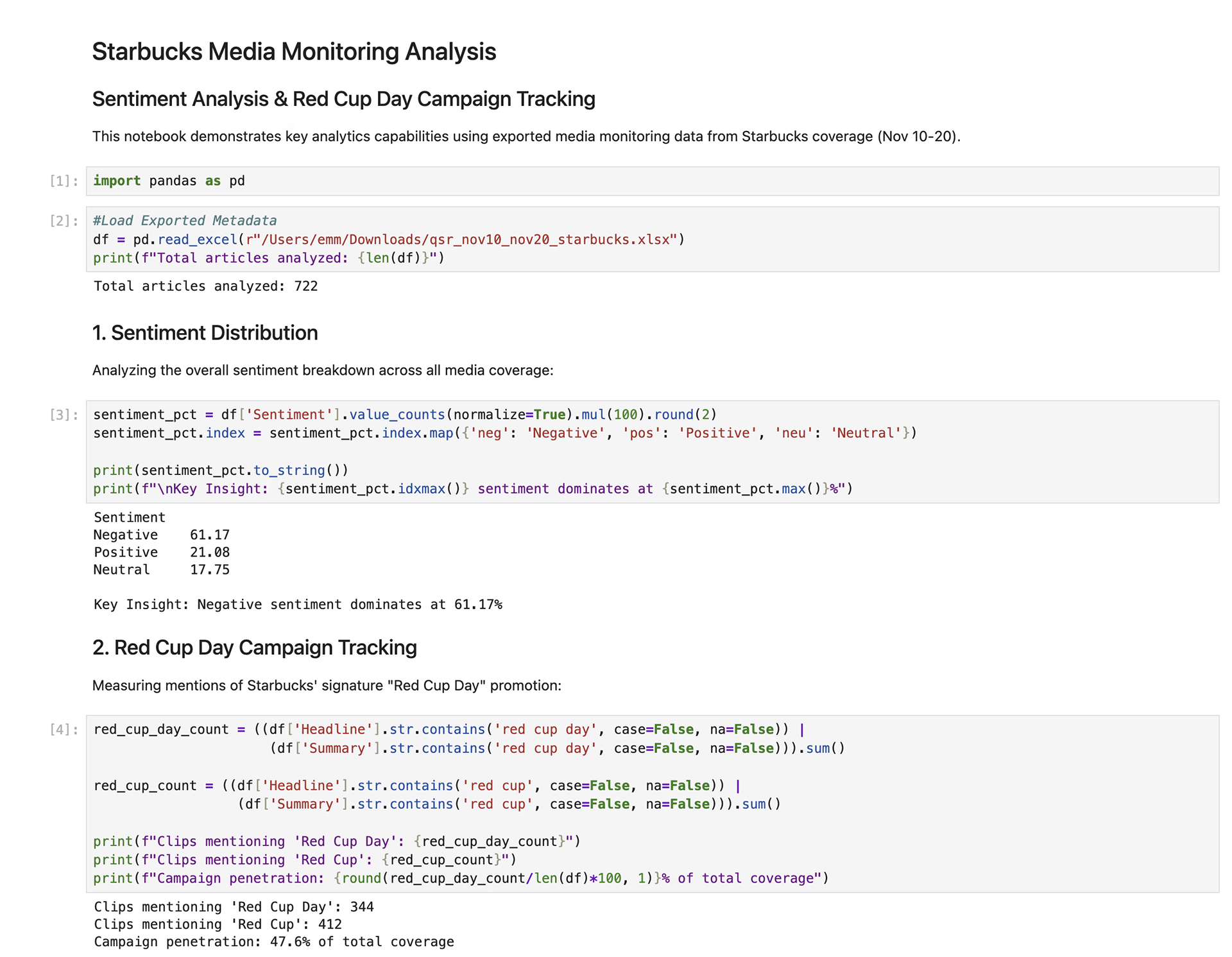
Analytics Demonstration (Jupyter Notebook)
You can access clips, transcripts, metadata, and analytics through the platform, export tools, or API, enabling flexible workflows.
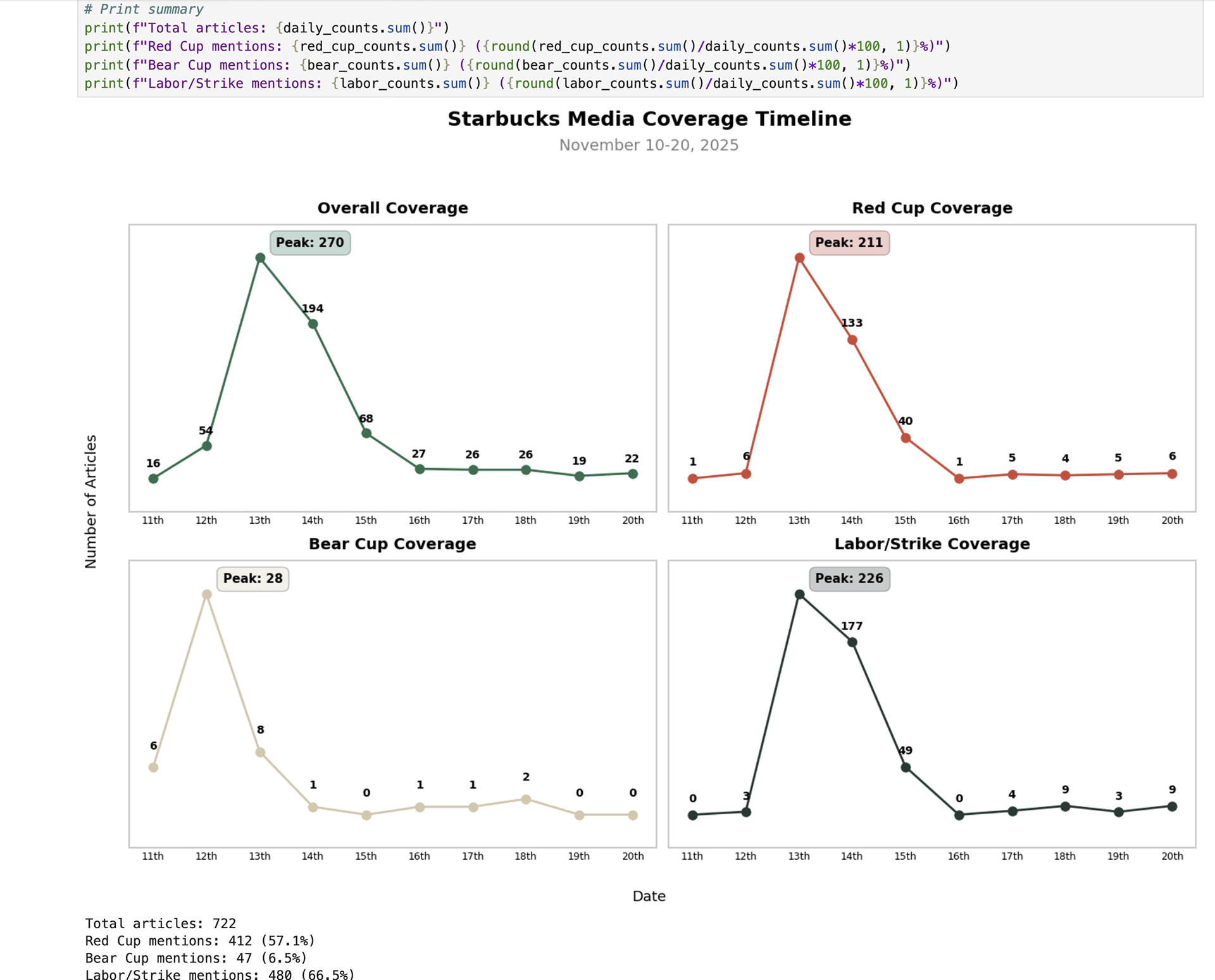
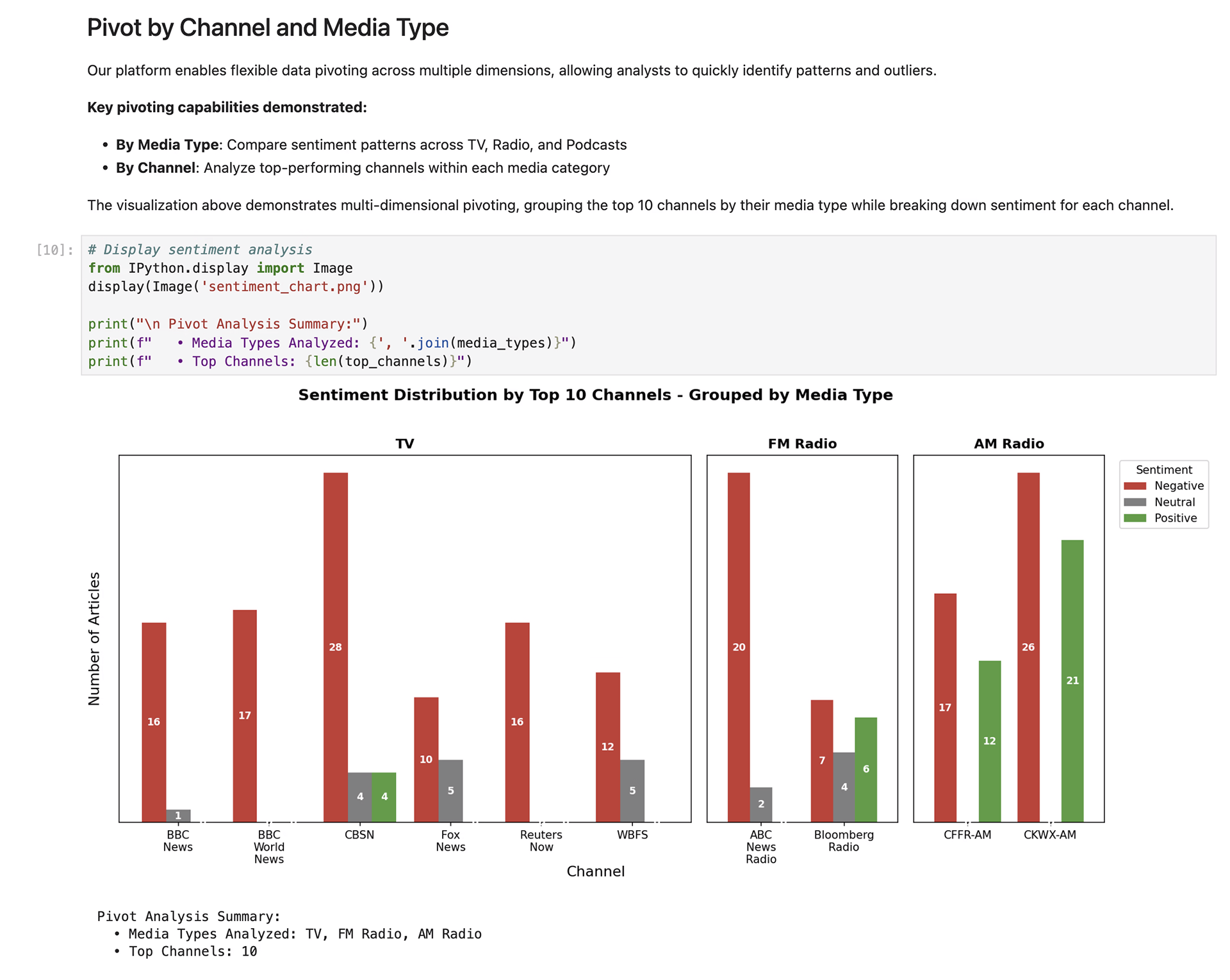
Type of workflow you can showcase inside a notebook:
- Load exported metadata
- Filter by keyword or sentiment
- Identify anomalies or peaks
- Visualise trends
- Pivot by country, channel, or media type
- Export for BI dashboards
Use Cases / Areas of Application
Data can be exported in structured formats for seamless integration into analytics environments.
A wide range of supporting analyst-driven scenarios:
- PR crisis monitoring
- Reputation & sentiment tracking
- Executive visibility monitoring
- Competitor benchmarking
- Industry insights
Practical examples:
- Formula 1 racing analysis
- Global Oscars overview
- E-sports reporting
- Restaurant sector intelligence
- CEO visibility tracking
Documentation, Training & Support
eMM provides a full support ecosystem with a user guide, Knowledge Base, and Support Wizard for quick answers, plus optional live or remote training and technical documentation for advanced workflows.
Performance, Reliability & Security
The platform includes built-in tools, documentation, and support resources that help you configure searches, manage data, and get the most value out of the analytics workflow.
Key technical assurances:
- ~30-second alert latency
- 30-day archive (long-term optional)
- 99% uptime
- Reliable API
- Scheduled platform updates
- Modern security compliance
Trials & Evaluation Options
Choose between a Free 3-Day Trial, which is open to everyone with Google login, or opt for a Custom Full Trial, available after a demo period. The latter one requires assessment with your eMM representative.
You can use one of the following options:
- a Free 3-Day Trial
- a Custom Full Trial
What’s Included in Every Contract
Access to our API can be used to automate searches, retrieve clips and metadata, and integrate the platform’s broadcast intelligence directly into your internal systems and applications.
Standard offering:
- Unlimited search profiles
- Unlimited searches
- Core analytics widgets
- Real-time alerts
- 30-day archive
- Super Profiles for extended clips
Premium Add-Ons:
- Auto summaries (optional)
- Long-term archive (optional)
- AVE (optional)
- Auto-fill (optional)
Case Studies & Testimonials
Clients consistently achieve measurable communication and market insights through real-world use of the platform.
A list of deliverables you can expect:
- Brand reputation monitoring
- Faster crisis detection
- Competitor movement tracking
- Market & industry trend identification
- Executive visibility insights
- Product launch monitoring
ROI & Value
You can tailor outputs, dashboards, alerts, and data formats to match your team’s workflow, ensuring the platform fits seamlessly into your existing analytical processes.
O automated approach saves you hours thank to:
- Faster crisis response
- Cross-market visibility
- Automated workflows
- Reduced manual monitoring
- Higher insight quality with fewer resources
Why Choose eMM
You can combine real-time clips, transcripts, metadata, and analytics to build complete monitoring workflows that track issues, surface insights, and support fast, evidence-based decisions.
Here is why eMM is worth considering:
- Real-time global coverage
- Monitoring in nearly 40 languages
- Super Profiles for multi-mention clips
- Rich transcripts, metadata, analytics
- In-house proprietary technology
- Extensive coverage network
- Trusted European private company
- Optional analyst insights
Pricing Structure
These outputs give you multiple ways to work with the data, depending on whether you need quick insights, detailed analysis, or direct integration into other tools.
Our packages are tailored based on:
- Countries
- Sources
- User needs
- Add-ons
Quotes are provided individually.
Ready to Explore eMM?
If you’re evaluating broadcast data for your organization, we’d love to walk you through sample data, coverage, analytics, and integration options.